Tuesday, June 28, 2022

Flying Shear of Rolling Mill

flying shear

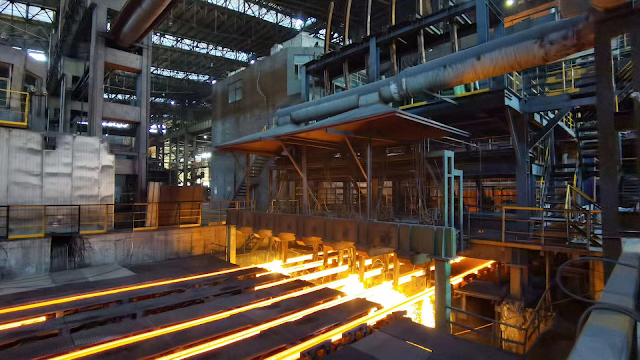
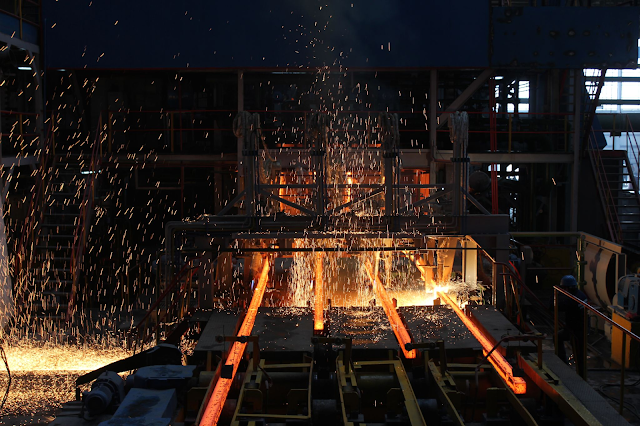
The shears used for transverse shearing of moving rolled pieces are called flying shears. With the development of continuous steel plate mills, section steel mills and billet mills and the improvement of flying shear productivity, flying shear is more and more widely used.

There are many types of flying shears, which are widely used: disc flying shears, double drum flying shears, crank rotary and pendulum flying shears, etc.

1. Disc-type Flying Shear 

This kind of flying shear is generally used in the small rolling locomotive rooms. It is installed in front of the cooling bed to roughly cut the rolled pieces so that the rolled pieces entering the cooling bed will not be too long; before installation in the finishing mill, the rolled piece shall be cut to ensure the smooth-rolling process of the finishing mill. The flying shear is composed of two or more pairs of disc-shaped blades, and the axis of the disc is equal to the moving speed of the steel. 

When the flying shear is in the original position, the steel advances along the inlet duct to the left of the flying shear. When the steel acts on the flag switch or optical waveguide, the inlet conduit and the steel deflect to the right, and the steel enters the middle of the two discs for shearing. After the lower blade descends, the guide tube returns the steel to the original left position, and then the lower blade rises again. The disadvantage of this kind of flying shear is that the cut is inclined, but it has little effect on the rough cutting of rolled pieces before cutting or cooling beds. Due to its reliable operation, simple structure, and shearing speed of more than 10m/s, the shear has been widely used in small rolling locomotives.

2. Double Drum Flying Shears 

Double drum flying shears are widely used to shear steel sections and plates in motion. Their working principles are as follows:

On the two rotating rollers, two blades are fixed radially. When the rolled piece moving along the roller table passes through the middle of the two rollers, it is sheared by the two blades that meet. The circumferential speed of the blade shall be slightly greater than the moving speed of the rolled piece, otherwise, the rolled piece will bend at the inlet during shearing.

The disadvantage of this kind of flying shear is that the section is not smooth when cutting thick rolled pieces (it has too much influence on cutting thin rolled pieces); When cutting wide steel plate, the shear force is large. Therefore, this kind of flying shear is used to shear small sections and thin plates of high-speed rolled pieces.

3. Crank Rotary Flying Shear 

Its shearing mechanism is composed of a four-bar linkage mechanism, and the shearing edge moves in an approximate plane in the shearing area and is perpendicular to the surface of the rolling piece. Therefore, the cut section of the rolled piece is relatively straight. The shearing mechanism of the flying shear is composed of a tool holder, an eccentric sleeve, and a swing rod. The tool holder is in the shape of a lever, one end of which is fixed on the eccentric sleeve, and the other end is connected with a swing rod. The swing fulcrum of the swing rod is hinged to the column. 

When the eccentric sleeve (crank) rotates, the tool holder moves in translation, and the blade fixed on the tool holder can be perpendicular or approximately perpendicular to the rolling piece. When shearing steel plates, an oblique blade can be used to reduce the shearing force. The disadvantage of this flying shear is that the structure is complex, the dynamic load characteristics of the shearing mechanism are poor, and the movement speed of the blade cannot be too fast. Generally used for shearing thick steel plates or billets.

4. Pendulum Flying Shear

The pendulum flying shear is sometimes used in the cross-cutting unit of the continuous steel plate rolling locomotive. The blade of the flying shear also makes translational movement, and the quality of cutting plates is good. The upper tool rest is fixed on the swing frame. The swing frame is supported by the eccentricity of the main shaft. There are two pairs of eccentricities on the main shaft, of which the other pair is connected with the lower tool rest through the connecting rod, and the lower tool rest can slide into the chute of the swing frame. Due to the difference of 180 ° between the two eccentric positions on the main shaft, when the main shaft rotates, the upper tool rest descends with the frame, while the lower tool rest rises to complete the shearing action. However, it can only shear stationary rolled pieces.

In order to shear the moving rolled piece, it is necessary to make the swing frame swing back and forth. The lower part of the swing frame is hinged with an eccentric rod, and the eccentric wheel is installed on the rear axle. The rear axle is connected to the main shaft through pinion, rack, and synchronizing disc. When the spindle rotates, the frame can swing back and forth with the spindle as the center by synchronizing the disc, rack, pinion, and the eccentric connecting rod on the rear axle. At this time, the tool rest moves in translation to realize the cutting work of the pendulum flying shear.

The role of shears in the rolling mill is not the key position, but it plays a vital role in the accuracy and shape of finished products. Different types of rolling mills should select the corresponding flying shears, so that the whole production line can achieve the target size and accuracy.

If you are interested in the shearing machine of rolling mill, please contact me freely.

Email: marketing2@hanrm.com; inquiry88@metallurgy.com; kerrirollingmill@gmail.com.

Whatsapp & Wechat:+86 18392033938

Website: www.hanrm.com; www.hanmetallurgy.com; www.steelrollingmillmachine.com


Kindly click on the article you are interested in:


Steel Rebar Rolling Mill Process Flow

Hot Rolled Steel and Cold Rolled Steel

Hot Rolled Steel Plate VS Cold Rolled Steel Plate

What is Metallurgical Equipment?

Multi-roll Mill VS Common Mill?

Hot Rolling Process VS Cold Rolling Process

Finishing Rolling Mill Process Explanation

Three Basic Laws of Steel Rolling

Reasons and Solutions for the Piling of Wire Rod Rolling

The Main Rolling Processes of the Wire Rod Mill Production Line

Production Process of Wire Rod

Laying Head of Wire Rod Mill

Characteristics and Quality of Steel Wire Rod

Sendzimir Mill Features

What are the Main Advantages of the Step-Type Cooling Bed?

Walking Beam Cooling Bed

Morgan Wire Rod Mill

What is a Cold Roll?

Crank Type Flying Shear

What is the Difference Between a 2 Hi Rolling Mill and a 4 Hi Rolling Mill?

What is the Universal Mill?

Why does the Steel Bar Bend after being Cut by Flying Shears?

Aluminum Rolling Mill Process

Continuous Rolling, Semi-continuous and Slit Rolling Processes of Rolling Mills

What’s the difference between hot and cold rolling mills?

Oil and Gas Lubrication in Bearing of High-Speed Rolling Mill

High-Speed Wire Rod Finishing Mill’s Troubleshooting Method for Burning Bearing Bush of Roller Box

What are the Main Accessories of the Rolling Mills?

Features of Hot Rolling and Controlled Cooling

Headless Welding Rolling Process

Bar Rolling Mills Water Cooling Technology

What is Wire Rod Mill?

Raw Material of Monoblock Mill (Wire Rod Mill)

Products of High-Speed Wire Rod Mill

Causes of Surface Cracks in Wire Rod Rolling Mill

Aluminum Hot Rolling Mill

Billet Selection and Heating of Hot Rolled Wire Rod Mill

Finishing Mill Main Features

What is Slit Rolling?

Causes and Solutions of Steel Piling-up in Wire Rod Rolling Mills?

Bar Automatic Counting System

Rebar Rolling Mills Control Cooling Method after Rolling

Monoblock Wire Rod Mill High-Quality Control

Rolling Mill Pass Design Selection

What is the Rolling Steel Production Process?

How to Improve the Production Efficiency of Cold Rolling Mills?

Main Methods of Wire Rod Rolling

Main Causes and Solutions of Vibration of Laying Head

Hot Tinning Plating Production Process

Sendzimir Mill

Tuesday, June 7, 2022

Cold Rolling Process and Characteristics of Forged Steel

cold rolling process

The so-called cold rolling of forged steel is not simply "cold rolling". Annealing, pickling, grinding, etc. are required before cold rolling, and leveling, straightening, shearing, stacking, etc. are required after cold rolling, so it is actually the whole process from the hot rolling coil to cold rolling finished products.

Due to the characteristics of cold rolling of forged steel and special requirements for product quality, the cold rolling production process has the following characteristics:

1. Cold rolling of forged steel is a kind of high alloy steel, which has great rolling deformation resistance. In order to carry out high-efficiency and high-precision rolling, the mill with high rigidity should be used, and the multi-roll cold rolling mill is generally used.

2. When the strip steel is cold rolled on the reversing mill, the head and tail parts wound on the coiler cannot be pressed down and are cut off as scrap. In order to change this situation and improve the yield, both ends of the strip steel should be welded before rolling; In addition, if the weight of the hot-rolled coil is too small, in order to improve the rolling efficiency and yield, the steel coil needs to be welded in advance; On the continuous annealing and pickling unit, the head and tail connections of the steel strip also need to be welded due to the continuous operation. Therefore, welding is an indispensable link in the cold rolling of forged steel. However, the cold rolling welding of forged steel is different from that of ordinary steel, which is much more difficult to weld; In particular, some welds need to be under pressure, and the requirements for welding quality are much stricter. Therefore, the special welding process is also a feature of the cold-rolled strip production of forged steel.

3. During the cold rolling production of forged steel, the raw materials (hot-rolled coil) shall be annealed, the intermediate annealing shall be conducted during the cold rolling process, and the final products shall be annealed. Therefore, annealing is an important link in production. However, there are many kinds of cold-rolled forged steel. The properties of various steels are different. The purpose, methods and requirements of heat treatment are different from those of general steel. There is a unique process system.

4. Cold rolling of forged steel is a kind of high-grade steel product. The requirements for surface quality are very strict. Not only metallurgical defects caused by the previous process, but also obvious defects caused by the cold rolling process are not allowed. Therefore, a series of elimination and protection measures have been taken in the production process. For example, in order to eliminate the hot-rolled scale, the hot-rolled strip steel should be shot-peened and pickled; In order to eliminate the defects caused by billets and after cold rolling and heat treatment, the strip steel often needs to be polished on the grinding unit; In order to ensure the surface quality after cold rolling, there are very strict requirements for roll grinding; In order to prevent scratches in the production process, the steel coils of each unit are required to be rolled tightly and neatly, and many units before and after cold rolling must pad process paper between the layers of the steel coils。

In addition, some special protective measures have been taken for operations and equipment that are prone to scratch; In order to obtain a good and uniform surface gloss, the finished product should be pickled after annealing, and the bright plate with special requirements should be annealed in the protective atmosphere; In order to protect the surface of finished products, some products have to be coated on the surface. In a word, the production of cold rolling of forged steel is an exquisite process, which is incomparable with other steel grades.

5. The finishing of cold rolling of forged steel is also different from that of ordinary steel. There are some special requirements. For example, the flatness process should not only improve the shape of the plate, but also use rollers with a high finish (except for hemp panels) to produce a smooth 2B steel plate. For ferritic steel, the formability of the steel plate should be improved by controlling the flattening reduction (or elongation), which is actually a kind of quenching and tempering rolling. Cold rolling of forged steel must be straightened with a strong straightener because the steel is hard and has strict requirements on flatness, and products of different thicknesses often need different straightening methods. Cold-rolled products of forged steel are usually delivered in two ways: coil forming and plate cutting, and some products need to be delivered in strips. Therefore, the modern cold rolling mill of forged steel should be equipped with longitudinal and transverse cutting units respectively.

5. The production of cold rolling stainless steel is a joint operation of multiple units. Process balance and process management are very important. A strong production scheduling system is necessary to ensure continuous high-quality production. In addition, the equipment of a cold-rolled stainless steel plant is relatively complex. There are many units and many high-quality, precision and advanced equipment, involving the technology of machinery, electricity, instrument automation, thermal engineering and other aspects. Doing well in equipment management is the fundamental guarantee to improving the production level and product quality.


Cold rolling process of forged steel

The difference between the production process of forged steel cold rolled strip and that of the general cold-rolled strip is that the forged steel cold rolled strip must be annealed before cold rolling and the surface of the strip must be kept clean at any time in the production process, so as to improve the yield and corrosion resistance.

The production process of forged steel cold rolled strip is as follows: hot rolled strip (blank) - annealing, alkali and pickling - Inspection and grinding - cold rolling - annealing, alkali and pickling - leveling - polishing - shearing - Inspection and classification - Packaging - warehousing.

Ferritic and martensitic steels have a long annealing time to facilitate recrystallization and dissolution of carbides. It is usually annealed in a bell-type furnace at an annealing temperature of about 800 ℃ for 2 ~ 6h. Ferritic steel shall be rapidly cooled in air to prevent embrittlement. Rapid cooling of martensitic steel is not allowed to avoid excessive internal stress and hardening crack. Austenitic steel is heated at 1000 ~ 1100 ℃ in a continuous furnace and cooled rapidly in water or air.

The annealed strip steel shall be shot blasted to break the iron oxide scale on the surface, and then enter the pickling tank after brushing to completely remove the iron oxide scale and passivate the surface. Generally, nitric acid or sulfuric acid is used for pickling. The temperature of the nitric acid solution is 20 ~ 55 ℃, and that of the sulfuric acid solution is 50 ~ 70 ℃.

The annealing and pickling of cold-rolled strips of forged steel are generally carried out in the annealing and pickling line.

After the pickling strip steel is inspected, the surface defects are repaired on the belt grinder, and then sent to the cold rolling mill for rolling. Cold rolling of forged steel is a kind of hard to deform steel, which is easy to produce work hardening during cold rolling, especially during multi-pass low compressibility rolling. Forged steel cold-rolled strip is generally rolled on four high mill and multi high mills, such as partial eight high mills (MKW mill) and twenty high mills. For austenitic steel that is easy to roll, the compression ratio of each pass shall not exceed 25%, and the total compression ratio of each rolling pass shall not exceed 75%. For martensitic steel with high carbon content, the compression ratio of each pass is 15%, and the total compression ratio of each rolling pass is not more than 50%.

After the completion of one rolling pass, it needs to be subject to intermediate annealing and pickling to eliminate cold rolling work hardening (recrystallization annealing). For austenitic steel, the heating temperature is 1050 ~ 1080 ℃. For Ferritic and martensitic steels, the heating temperature is about 800 ℃. Quenching in water, air or steam after heating. The iron scale produced during heat treatment is oxidized and loosened in the salt bath furnace to facilitate acid pickling.

After pickling, the surface of the strip steel shall be inspected and the defects shall be removed from the grinding machine. The finished cold rolled strip of forged steel is subject to bright annealing, that is, the last recrystallization annealing in a non-oxidizing atmosphere. Decomposed ammonia is usually used as protective gas.

After bright annealing, grinding and polishing are generally not carried out to maintain the obtained surface roughness of the strip steel. The purpose of flatness is to improve the surface quality of strip steel, improve the shape of strip steel and eliminate the yield platform. The compression ratio during leveling is generally not more than 2%. In order to obtain a very smooth strip surface, the roll should be polished frequently during the leveling process.

In order to improve the corrosion resistance of forged steel cold rolled strip, some special kinds of forged steel cold rolled strips must be ground and polished. Generally, wet grinding (oil and emulsion) is used to prevent burning spots or cracks caused by the poor thermal conductivity of cold-rolled forged steel. The polishing process consists of polishing and wiping. Generally, the emulsion is used as a polishing agent. In order to prevent the surface of the strip steel from being scratched, the surface of all rollers in contact with the strip steel in the whole process must be very smooth, or the rubber-coated roller shall be used. During coiling, the paper tape must be padded between each layer. For the collection of finished products, the paper shall be padded between each layer to protect the surface from mutual scratch.


If you are interested in cold rolling mill machine or relevant machine, please mail at marketing2@hanrm.com or kerrirollingmill@gmail.com.


TAKE A LOOK ABOUT THE OTHER OUR ARTICLES
Kindly click on the article you are interested in:


What Are the Advantages of Slitting Rolling?

The Flying Shears of Steel Rolling Mill

Steel Rebar Rolling Mill Process Flow

Energy Saving and Emission Reduction in Steelmaking Production

Hot Rolled Steel and Cold Rolled Steel

Hot Rolled Steel Plate VS Cold Rolled Steel Plate

What is Metallurgical Equipment?

Multi-roll Mill VS Common Mill?

Hot Rolling Process VS Cold Rolling Process

Finishing Rolling Mill Process Explanation

Three Basic Laws of Steel Rolling

Reasons and Solutions for the Piling of Wire Rod Rolling

The Main Rolling Processes of the Wire Rod Mill Production Line

Production Process of Wire Rod

Laying Head of Wire Rod Mill

Characteristics and Quality of Steel Wire Rod

Sendzimir Mill Features

What are the Main Advantages of the Step-Type Cooling Bed?

Walking Beam Cooling Bed

Morgan Wire Rod Mill

What is a Cold Roll?

Crank Type Flying Shear

What is the Difference Between a 2 Hi Rolling Mill and a 4 Hi Rolling Mill?

What is the Universal Mill?

Why does the Steel Bar Bend after being Cut by Flying Shears?

Aluminum Rolling Mill Process

Continuous Rolling, Semi-continuous and Slit Rolling Processes of Rolling Mills

What’s the difference between hot and cold rolling mills?

Oil and Gas Lubrication in Bearing of High-Speed Rolling Mill

High-Speed Wire Rod Finishing Mill’s Troubleshooting Method for Burning Bearing Bush of Roller Box

What are the Main Accessories of the Rolling Mills?

Features of Hot Rolling and Controlled Cooling

Headless Welding Rolling Process

Bar Rolling Mills Water Cooling Technology

What is Wire Rod Mill?

Raw Material of Monoblock Mill (Wire Rod Mill)

Products of High-Speed Wire Rod Mill

Causes of Surface Cracks in Wire Rod Rolling Mill

Aluminum Hot Rolling Mill

Billet Selection and Heating of Hot Rolled Wire Rod Mill

Finishing Mill Main Features

What is Slit Rolling?

Causes and Solutions of Steel Piling-up in Wire Rod Rolling Mills?

Bar Automatic Counting System

Rebar Rolling Mills Control Cooling Method after Rolling

Monoblock Wire Rod Mill High-Quality Control

Rolling Mill Pass Design Selection

What is the Rolling Steel Production Process?

How to Improve the Production Efficiency of Cold Rolling Mills?

Main Methods of Wire Rod Rolling

Main Causes and Solutions of Vibration of Laying Head

Hot Tinning Plating Production Process

Sendzimir Mill


Wednesday, June 1, 2022

Application And Development of High- speed Steel Roll

steel roll

The application of cast high-speed steel roll in steel rolling production began in 1988, when it was used on a hot strip mill in Japan. Subsequently, the United States and Europe began to introduce the technology of casting high-speed steel rolls. The cast high-speed steel roll was initially used in the front section of the finishing mill of the hot strip mill to replace the high chromium cast iron roll. Later, the cast high-speed steel roll was also used in the finishing and roughing sections, wire rod, bar and cold-rolled strip mills, and satisfactory results were obtained.

The cast high-speed steel composite roll produced by Nippon Steel Corporation with CPC method has high wear resistance. After using the cast high-speed steel rolling rod, the steel passing per millimeter is significantly increased, the number of roll changes is significantly reduced, and the roll grinding amount is reduced. The main reason is that high-speed steel rolls contain high hardness carbides such as MC and M6C. In addition, the matrix structure of high-speed steel rolling rod is composed of stable and high hardness martensite and good hardenability and hardenability, which makes the hardness drop of high-speed steel roll significantly smaller than that of other rolls. These characteristics can ensure that the roll has good wear resistance during the whole working period.

In order to improve the production efficiency of the steel tube mill and reduce the roll consumption, the use of high-speed steel rolls in the steel tube mill is also quite successful. High-speed steel rolls have excellent wear resistance and resistance to surface orange peel defects. Their service life is 6-10 times longer than that of traditional rolls, and there is no steel sticking. Since the trial use of cast high-speed steel rolls in 1993, the Canadian Dofasco company has continuously increased the proportion of use. At present, cast high-speed steel rolls have been used on F2, F3, and F4 racks. After using the high-speed steel roll, the roll consumption is significantly reduced, and the rolling mill operation rate is significantly improved. The average steel passing capacity of F4 stand is increased from 360 t /h in june1992 to 490 t/h in november1994, and the strip surface quality is improved by 20%.

The semi-high speed steel composite roll produced by Hitachi has also achieved good results in rolling mills. Compared with the conventional forged steel roll containing 5.0%cr and 10.0%cr, the semi-high speed steel roll has less wear and a shallow fatigue layer, so the roll consumption is significantly reduced. For the production of the same amount of cold-rolled strip, the roll consumption is only 21% of that of 5.0%cr steel. Recently, the 2050 hot rolling mill of the Vanderbijlpark plant in South Africa used the new hss7 high-speed steel roll developed by Marichal ketin company in Belgium. The steel rolling volume per mm was increased to 12000t, while the ordinary high chromium cast iron roll was only 5000 t. After using high-speed steel rolls, the surface quality of the hot-rolled strip is greatly improved, and the problem of strip quality degradation caused by the iron oxide scale is reduced by 2/3. Using high-speed steel rolls has good economic benefits.

Baosteel 2050 hot strip roughing mill adopts semi high-speed steel roll, which has excellent hot crack resistance and wears resistance, and its service life is more than twice that of the original high chromium cast iron roll; When used in the front stand of finish rolling, its wear resistance is three times that of high chromium cast iron roll, and effectively overcomes the defect of spot strip. It can roll high surface quality strips, prolong the roll change cycle, and improve the production rate of the mill. The high-speed steel roll has been used in the front section of rough rolling and finish rolling of 158opc mill, and it also has good results. Hansteel uses high-speed steel rolls for F2, F3 stands and sometimes F1 stands of CSP production line. It mainly rolls SS400, SPHC, spa2h and other steel grades. The corresponding thickness ranges are 1.8-6 mm and 1 5-3 mm,3-6 mm。 According to the statistics, the millimeter rolling volume is 10500 T, 7800 T and 8200 t respectively, and the average millimeter rolling volume reaches 8900 T, which is 2-3 times that of ordinary high chromium iron rolls. The surface quality of the products is significantly improved; The roll can be used continuously for 2-3 times in each cycle. The roll grinding can be reduced by 1.6 times and the grinding loss can be reduced by 0.4 mm. Under normal conditions, the consumption of each roll can be reduced by about 25 RNM.

The general iron and Steel Research Institute selects high-carbon high-speed steel as the working layer, alloy nodular cast iron as the roll center, and the centrifugal casting method is used to manufacture high-speed steel composite rolling rod, which has the characteristics of high working layer hardness and uniform roll body hardness. The comprehensive life of the rolling mill for the hot-rolled narrow strip is 10.5 times longer than that of the high-alloy cast iron roll. Although the hardness (HRC 65) and wear resistance of the high-speed steel roll ring are not as good as that of the cemented carbide roll ring, the heat cracking resistance is much better than that of the cemented carbide roll ring. Its single groove rolling capacity can reach about 6500 T, which is nearly 1 time higher than that of the cemented carbide roll ring. The total rolling capacity of a pair of high-speed steel roll rings and a pair of cemented carbide roll rings is roughly the same. The benefit of replacing the cemented carbide roll ring with a high-speed steel roll ring is very obvious. In addition, due to the high rolling volume of the single groove of a high-speed steel roll ring, the time of roll change and groove change can be reduced and the operation rate can be improved; The weight of a single piece is much lower than that of cemented carbide roller ring, which can reduce the labor intensity of workers; The refitting of the roll ring only needs to be processed on an ordinary lathe, which reduces the processing cost.

However, when using the high-speed steel roll, it should be noted that the high-speed steel roll is easy to form a temperature difference on the roll due to its poor heat dissipation, so as to reduce the service life of the roll. It is necessary to strengthen the cooling capacity of the roll and keep the roll surface temperature below 50 ℃. In addition, high-speed steel has low toughness and accident resistance. It is suitable for hot rolling mills with stable equipment conditions. In case of any abnormality during the rolling mill operation, it is necessary to stop the mill for inspection at any time to avoid serious roll breakage accidents. When using a high-speed steel roll, because the working roll has high hardness, the relative support roll also needs to be changed from the original cast steel to forged steel.

The grinding properties of high-speed steel are quite different from those of traditional rolls. The equipment, grinding materials and management of the roll grinding workshop should be improved in order to give full play to the special properties of high-speed steel rolls. In addition, it is also important to work to find the cracks in the use of high-speed steel rolls as early as possible and prevent crack propagation. As the compressive residual stress of high-speed steel roll is larger than that of ordinary roll, cracks are not easy to be found. It is necessary to carry out online eddy current flaw detection, ultrasonic flaw detection or magnetic particle flaw detection on the roll that has been removed from the rack on-site, and timely repair and clean the cracks found.

As a professional rolling mill manufacturer with 26 years of experience, we can supply rebar rolling mills, wire rod rolling mills, roughing rolling mills, intermediate rolling mills, finished rolling mills, short stress rolling mills, strip steel rolling mills, hot rolling mill, cold rolling mill, continuous casting machine, continuous caster, electric arc furnace, submerged arc furnace, ladle refining furnace, blast furnace, induction furnace, flying shear, cold shear, chopping shear, gripping shear, cooling bed, pinch roll, rebar tying machine, mill roll, Cardan shaft, and related spare parts. 


If interested, please mail at marketing2@hanrm.com or kerrirollingmill@gmail.com.


kindly click the articles you may be interested in:

The Importance of the Roller   

Universal Joint Shaft Production Process    

Steel Rebar Rolling Mill Process Flow   

How to Choose Cardan Shaft?   

Requirements for Tungsten Carbide Roll Rings    

Roll Forming Method and Process     

What are the Precautions When Removing the Cardan Shaft?     

Sendzimir Mill Features     

Universal Coupling Assembly    

New Process Sendzimir Roll Features    

Cardan Shaft Assembly and Routine Maintenance    

What is a Cold Roll?    

Analysis of the Swing Angle of Cardan Shaft in Operation    

Cardan Shafts Assembly and Daily Maintenance     

Development of High-Speed Steel Rolls    

How are the Rolls Classified by Material?    

Design of Mill Rolls for Rolling Mill and Material of Rolls     

The Cause of Rolling Mill Rolls Breakage    

Material Selection of Rolling Mill Rolls    

On the Application of Cardan Shaft in Hot Strip Steel Rolling  

 An Effective Way to Reduce Mill Roll Consumption   

Material Selection of Rolling Mill Rolls     

Roller FAQs

Thursday, May 19, 2022

Forging VS Casting

continuous casting

1. Differences between Forging and Casting:

1.1 Different Definitions:

Forging: use hammering and other methods to make the metal material in the plastic state into a workpiece with a certain shape and size, and change its physical properties.

Casting: the processing method of melting metal into a liquid, pouring it into the mold, cooling, solidification, and cleaning to obtain the casting with the required shape. It can be made into various objects with complex shapes.

1.2 Different Manufacturing Processes:

Forging: it is a processing method that uses forging machinery to exert pressure on the metal blank and make it produce plastic deformation to obtain forgings with certain mechanical properties, certain shapes, and sizes. It is one of the two components of forging (forging and stamping).

Casting: it is a method of casting liquid metal into the casting cavity corresponding to the shape of the part, and obtaining the part or blank after it is cooled and solidified.


2. Forging and Casting Purposes:

Forging is generally used in the processing of forgings with a certain shape and size.

Casting is an economical blank forming method, which is generally used in parts with complex shapes.


3. Advantages and Disadvantages of Forging and Casting:

3.1 Forging Advantages:

Forging can eliminate the defects such as cast porosity in the smelting process and optimize the microstructure. At the same time, due to the preservation of a complete metal streamline, the mechanical properties of forgings are generally better than those of castings of the same material. For important parts with high load and severe working conditions in relevant machinery, forgings are mostly used, except for rolled plates, profiles, or weldments with a  simple shape.


3.2 Casting Advantages:

1)It can produce parts with complex shapes, especially blanks with complex cavities.

2) Wide adaptability. Metal materials commonly used in industry can be cast, ranging from a few grams to hundreds of tons.

3) Raw materials come from a wide range of sources and are cheap, such as scrap steel, scrap parts, chips, etc.

4) The shape and size of the casting are very close to the parts, which reduces the cutting amount and belongs to non-cutting processing.

5) It is widely used. 40% ~ 70% of the weight of agricultural machinery and 70% ~ 80% of the weight of machine tools are castings.


3.3 Forging Disadvantages:

In forging production, trauma accidents are easy to occur.


3.4 Casting Disadvantages:

1) The mechanical properties are not as good as forgings, such as coarse structure, many defects, etc.

2) In sand casting, single-piece and small-batch production have high labor intensity.

3) The casting quality is unstable, there are many processes, and the influencing factors are complex, which is easy to produce many defects.


Forging is one of the important methods of metal plastic processing. The main purpose of forging is forming and modification (improvement of mechanical properties and internal structure). The latter is difficult to realize by other process methods. In addition, forging production also has the advantages of metal saving, high production efficiency, and great flexibility.

Through forging, the porosity and pores in the casting structure can be compacted, and the coarse casting structure (dendritic grains) can be broken into fine grains to firm fiber structure. When the fiber structure is reasonably distributed along the contour of the part, the mechanical properties of the part can be improved. Therefore, the forged parts have high strength and can withstand greater impact load.

Under the same impact load, the size of forged parts can be reduced, that is, metal can be saved. For example, the United States uses a 315mn hydraulic press to die to forge 272 parts and 3200 screws of F-102 J, which reduces the weight of the aircraft and replaces 45.5 ~ 54.5kg.

Casting is a manufacturing process in which molten metal liquid is poured into the mold and cooled and solidified to obtain the required shape and properties. Casting is a common manufacturing method with low manufacturing costs and great process flexibility. It can obtain complex shapes and large castings. It accounts for a large proportion of mechanical manufacturing, such as machine tools account for 60 ~ 80%, automobiles account for 25% and tractors account for 50 ~ 60%.

Due to the improvement of casting quality, casting precision, casting cost, and casting automation, casting technology is developing towards precision, large-scale, high-quality, automation, and cleaning. For example, China has developed rapidly in precision casting technology, continuous casting technology, special casting technology, casting automation, and casting molding simulation technology in recent years.


As a professional rolling mill manufacturer with 26 years experience, we can supply rebar rolling mill, wire rod rolling mill, roughing rolling mill, intermediate rolling mill, finished rolling mill, short stress rolling mill, strip steel rolling mill, hot rolling mil , cold rolling mill, continuous casting machine, continuous caster, electric arc furnace, submerged arc furnace, ladle refining furnace, blast furnace, induction furnace, flying shear, cold shear, chopping shear, gripping shear, cooling bed, pinch roll, rebar tying machine, mill roll, cardan shaft, and related spare parts.

We can supply completely rolling mill solutions including rolling passes design,production line setup, workshop layout according to customer's requirements, and Technical services and after sale technical supports.


Email: marketing2@hanrm.com; kerrirollingmill@gmail.com

TAKE A LOOK ABOUT THE OTHER OUR ARTICLES

Kindly click on the article you are interested in:

What Are the Advantages of Slitting Rolling?

The Flying Shears of Steel Rolling Mill

Steel Rebar Rolling Mill Process Flow

Energy Saving and Emission Reduction in Steelmaking Production

Hot Rolled Steel and Cold Rolled Steel

Hot Rolled Steel Plate VS Cold Rolled Steel Plate

What is Metallurgical Equipment?

Multi-roll Mill VS Common Mill?

Hot Rolling Process VS Cold Rolling Process

Finishing Rolling Mill Process Explanation

Three Basic Laws of Steel Rolling

Reasons and Solutions for the Piling of Wire Rod Rolling

The Main Rolling Processes of the Wire Rod Mill Production Line

Production Process of Wire Rod

Laying Head of Wire Rod Mill

Characteristics and Quality of Steel Wire Rod

Sendzimir Mill Features

What are the Main Advantages of the Step-Type Cooling Bed?

Walking Beam Cooling Bed

Morgan Wire Rod Mill

What is a Cold Roll?

Crank Type Flying Shear

What is the Difference Between a 2 Hi Rolling Mill and a 4 Hi Rolling Mill?

What is the Universal Mill?

Why does the Steel Bar Bend after being Cut by Flying Shears?

Aluminum Rolling Mill Process

Continuous Rolling, Semi-continuous and Slit Rolling Processes of Rolling Mills

What’s the difference between hot and cold rolling mills?

Oil and Gas Lubrication in Bearing of High-Speed Rolling Mill

High-Speed Wire Rod Finishing Mill’s Troubleshooting Method for Burning Bearing Bush of Roller Box

What are the Main Accessories of the Rolling Mills?

Features of Hot Rolling and Controlled Cooling

Headless Welding Rolling Process

Bar Rolling Mills Water Cooling Technology

What is Wire Rod Mill?

Raw Material of Monoblock Mill (Wire Rod Mill)

Products of High-Speed Wire Rod Mill

Causes of Surface Cracks in Wire Rod Rolling Mill

Aluminum Hot Rolling Mill

Billet Selection and Heating of Hot Rolled Wire Rod Mill

Finishing Mill Main Features

What is Slit Rolling?

Causes and Solutions of Steel Piling-up in Wire Rod Rolling Mills?

Bar Automatic Counting System

Rebar Rolling Mills Control Cooling Method after Rolling

Monoblock Wire Rod Mill High-Quality Control

Rolling Mill Pass Design Selection

What is the Rolling Steel Production Process?

How to Improve the Production Efficiency of Cold Rolling Mills?

Main Methods of Wire Rod Rolling

Main Causes and Solutions of Vibration of Laying Head

Hot Tinning Plating Production Process

Sendzimir Mill


Wednesday, May 11, 2022

600, 000 Tons of Rebar and Wire Rod Mill Solution

rebar and wire rod solution

 1. Brief introduction

----Annual capacity 600, 000T, adopting the full continuous process arrangement.

----Rough rolling Φ 550 × 6 (HV) 6 short stress continuous rolling units in total;

----Medium rolling mill 420 × 6 (HV) 8 short stress continuous rolling units in total;

----Bar finish rolling Φ 320 × 6 (HV) 7 short stress continuous rolling units in total;

----Bar finished product speed; 12~18m/s。

Wire rod finish rolling Φ 230 × 5-170 × 6 (HV) a total of 10 top cross torsion-free continuous rolling units;

2. Raw materials specification: continuous casting billets 130×130×6000mm

2.1 Steel grade, product specifications:

 Type of steel: Carbon steel, carbon structure steel, low alloy steel

Finished products rebar: Ø14×2two splitting rolling)、Ø16Ø18Ø20Ø22Ø25Ø32mmSeries of round steel and hot-rolled ribbed steel bar;

Finished products wire rod: Φ5.5~12.0mm

3. Process layout:

3.1 Rebar projection line

Ø550×6(H/V) Roughing mill1#6#Ø420×6H/VIntermediate mill7#12#Ø320×6H/VFinishing mill units13#18#. Fully continuous rolling type and adopts DC motor driving.

3.2 Technical process

3.3 Rebar production process

Billets(150×150~9000mm)----re heating furnace---furnace delivery table----Pneumatic pull shears(for accident)---Ø550×6(H/V) roughing mill16#(DC×6)-----1 # crank, start-stop flying shear (cut head and tail, accident broken off)----Ø420 × 6 (H / V) intermediate rolling mill 7 ~ 12 # (DC × 6)-----2 # crank, start-stop flying shear (cut head and tail, accident broken off)----1#  vertical pneumatic Loop----Ø320×6H/Vfinishing mill 1318#DC×6(Wherein before finish rolling, finishing each provided between 2 ~ # 6 # 6 pneumatic stand Loop )----flying shear pinch roll--- 3# double length flying shear (cutting head, multiple lengths)----Cooling bed input frequency Roller conveyor-----Rack type cooling bed-----Elevating alignment roll table-----size-bridges roller-way----Unloading steel devices----Cooling bed output table----500T Cold shear(cut to length)-----Pinto moving steel machine across----Test bench---Move the steel inspection----Bundling----Weighing----Signage----Be put into storage

If you are interested in our machine, please mail at marketing2@hanrm.com.

For more solutions you may be interested in, please check the links below.

1,000,000 Tons Hot Rebar Rolling Mill Line Rolling Case

5 T Induction Furnace for Sale

6300KVA Electric Arc Furnace Solution

300,000 Ton TPY Re-bar Production Line

30, 000 Ton Tpy Wire Rod Mill Production Line

Thursday, April 28, 2022

Main Factors Affecting the Crack of Sendzimir Roll

sendzimir roll

The crack of Sendzimir roll occurs at the transition from Sendzimir work roll body to upper roll neck, within 40 ~ 100mm from the upper end of Sendzimir work roll body. Most of the roll neck cracks are transverse cracks, including ring cracks and local cracks. If the crack is light, it can be found during processing. If the crack depth is less than the machining allowance, it can be removed during processing. If there are still cracks after processing, it shall be scrapped; If the crack is serious, a circle of ring cracks can be seen as cast, which will cause the roll neck to break in serious cases.


(1) Chemical composition. When producing rolls in a chemical furnace, the melting sequence is arranged from low to high according to the roll name (SI): cold hardening roll, ball core roll, ball compound roll, infinite cold hardening roll and nodular iron roll. In order to ensure that the outlet temperature of the first ladle of molten iron of 10t cupola is greater than 1400 ℃, the height of bottom coke is specified as 2.8m. Due to the high coke at the bottom of the cupola, the increment of W (c) and w (s) of the molten iron in the front several packages are relatively serious, resulting in the w (c) of the alloy chilled cast iron roll as high as 3.75% ~ 3.80%, w (s) as high as 0.115% ~ 0.120%, and sometimes even as high as 0.132%.


(2) Pouring temperature. When using cupola to produce rolls, the outlet temperature of the first and second ladle of molten iron in front is generally low. In addition, the temperature of the front furnace and molten iron ladle is low and the heat absorption is large, resulting in low pouring temperature of molten iron, poor fluidity of molten iron, early solidification of riser, crusting, damage to directional solidification and increase the tendency of cracks.


(3) The deeper the white layer of the roll, the greater the scrapping amount of Sendzimir roll crack. This is because the contraction of white mouth is larger than that of hemp mouth and gray mouth.


(4) The inner wall of the riser sand mold is uneven, which hinders the free downward contraction of the roll neck.


(5) The greater the ratio of the length of Sendzimir work roll body (L) to the diameter of Sendzimir work roll body (d), the higher the scrap rate of Sendzimir roll crack. as φ 355mm × L020mm roll, L / D = 2.87, the scrapping rate of Sendzimir roll crack is as high as 50%. The greater the ratio of L / D, that is, the longer the length of the Sendzimir work roll body, the greater the shrinkage in the length direction of the Sendzimir work roll body, and the higher the probability of tensile crack of the upper roll neck.


(6) The length of Sendzimir work roll body is more than 700mm, and the diameter of Sendzimir work roll body is less than φ For the 350mm slender roll with roll neck sand core, the sizing block is not removed after pouring, or the outer circle of the sand core is too large and fits too tightly with the cold mold, thus losing the function of reducing the shrinkage resistance of the roll neck sand core (which can move down after pouring).


(7) The crack of Sendzimir roller is related to the characteristics of pig iron. In the production process, it is often found that when a pig iron is replaced, the roll is prone to cracks (including longitudinal crack of Sendzimir work roll body, edge crack of upper and lower roll, neck crack, etc.), while after another pig iron is replaced, all kinds of cracks are reduced or disappeared. It may be due to the influence of heredity of cast iron structure, which increases the shrinkage of roll and is easy to cause cracks.


(8) When the tellurium content is too high, the crack tendency of Sendzimir roll increases. Adding tellurium to the cold hardening roll can increase the pure white mouth depth and shorten the length of the hemp mouth, which is conducive to improving the wear resistance of the roll and the surface quality of the steel. In order to obtain a relatively pure white layer, our factory adds 8 ~ 12g tellurium per ton of molten iron, which is higher than that of domestic peers, so the scrap rate of roll neck crack is also higher than that of domestic peers. Tellurium is a strong anti graphitization element. Due to the high amount of tellurium in molten iron, the amount of graphite precipitated during solidification is reduced and the tendency of crack generation is increased.


If you are interested in the Sendzimir Roll, please mail at marketing2@hanrm.com, or kerrirollingmill@gmail.com.

More Articles You May Be Interested:

Bar Automatic Counting System

Bar Rolling Process and Equipment Selection

The Advantages and Disadvantages of Hot Rolling

Hot Rolled Steel and Cold Rolled Steel

Hot Rolling Process VS Cold Rolling Process

What’s the difference between hot and cold rolling mills?

Features of Hot Rolling and Controlled Cooling

What is Metallurgical Equipment?

What is Laying Head?

The Main Factors Affecting the Quality of the Wire Rod

Technical Progress of High-speed Wire Rod Mills

Bar And Wire Rod Direct Rolling Technology without Heating

Common Phenomena and Processing Methods in Wire Rod Production

How to Improve the Assembly Quality of the Roller Box of the Wire Rod Mill?

Process Adjustment of Wire Rod Mill

Development of High-Speed Wire Rod Mill

Processing Technology of Parts in High-speed Wire Rod Mill

Wire Rod Mill Structure and Arrangement

The Production Process of Wire Rod

Technical Characteristics of Bar and Wire Rod Mill

Temperature-Control of Wire Rod Rolling


Monday, March 14, 2022

Continuous Casting and Rolling Process

 1. Requirements of the continuous casting production process on continuous casting equipment:


1) It must be suitable for the whole process of high-temperature molten steel from liquid to liquid-solid and then to solid;

2) It must have high-temperature resistance, fatigue strength and sufficient strength;

3) It must have high manufacturing and installation accuracy, easy maintenance and rapid replacement, sufficient cooling and good lubrication. 

continuous casting and rolling

2. What kinds of continuous casting machines are divided by the running track of continuous casting flow? Briefly describe the characteristics of each model?


1) Vertical continuous caster, vertical bending continuous caster, arc continuous caster, oval continuous caster and horizontal continuous caster.

2) A. vertical continuous caster: the billet shell of this caster is cooled evenly and is not subject to bending and straightening, so it is not suitable to produce internal and surface cracks, which is conducive to the floating of inclusions. However, the height of the equipment is large, the operation is inconvenient, the investment cost is high, the equipment maintenance and accident handling are difficult, the billet section, fixed length and drawing speed are limitedMoreover, the deformation of the slab belly is prominent due to the large static pressure of molten steel.

B. Vertical bending continuous caster: the tundish, mould, guide roller and dummy bar of the caster are distributed along the vertical line. The cutting machine of the tension leveler is arranged horizontally, and the pouring and cooling solidification are completed in the vertical direction. After complete solidification, it is bent by 90 ° to enter the bending section, and the billet is discharged in the horizontal direction. Its caster height is lower than that of the vertical, which is convenient for transportation, and can meet the requirements of longer length. However, due to the addition of one-time bending and straightening, it will cause cracks.

C. Arc continuous caster: it is divided into single point straightening arc continuous caster, multi-point straightening arc continuous caster and straight mold arc continuous caster. 

a) Single point straightening arc continuous caster: advantages: the height is lower than that of vertical and vertical bending type, so the equipment weight is light, the investment cost is low, the installation and maintenance are convenient, the static pressure of molten steel on the slab is small, which can reduce the internal alignment and segregation caused by the strand belly, which is conducive to improving the casting speed and slab quality. Disadvantages: during the solidification process of molten steel, non-metallic inclusions tend to focus in the arc, resulting in uneven distribution of sundries in the slab. 

b) Multi point straightening arc continuous caster: advantages: the deformation rate of solid-liquid interface is reduced. When the slab is straightened with liquid core, there is no internal crack, which is conducive to improving the drawing speed. 

c) Advantages of straight mold arc continuous caster: it has the advantages of vertical type, which is conducive to the floating of large inclusions and the average distribution of inclusions in steel. It has higher height than vertical bending type and low construction cost. Disadvantages: the billet shell on the outer arc side of the billet is stretched, the two-phase area is easy to cause crack defects, the equipment structure is complex, and it is difficult to repair and maintain.


D. Oval continuous caster: its advantages are that its height is greatly reduced compared with arc, the static pressure of molten steel is low, the strand volume of billet is small, the central segregation of internal crack is improved, and the investment is saved by 20% - 30% (compared with arc). However, the inclusions in molten steel in the mold have almost no chance to float up, so the requirements for molten steel are strict.


E. Horizontal continuous caster: it has the advantages of the lowest equipment height, secondary oxidation of molten steel, improved slab quality, free from bending and straightening, conducive to crack prevention, simple equipment maintenance and convenient accident handling, but the separation at the connection between tundish and mold is expensive, the lubrication between mold and slab is difficult, the mold does not vibrate during blank drawing, which is suitable for the amount of small slab, Various pouring, square billet, round billet and special steel below 200mm.


3. Definition of continuous casting and rolling


The high-temperature defect-free billet produced by the continuous caster is directly rolled into a product without cleaning and reheating (but after short-term soaking and thermal insulation treatment). In this way, the process of directly connecting "casting" and "rolling" into a production line is called continuous casting and rolling.


4. Compact connection method of continuous casting and continuous rolling


Hot charging and direct rolling of continuous casting slab. The hot charging process of continuous casting billet refers to the method that the billet produced by the continuous casting machine is drawn into the heating furnace for heating without cooling, and then rolled. The direct rolling process of continuous casting slab refers to that the high-temperature slab from the caster is directly sent to the rolling mill for rolling without heating or only slight supplementary heating of the edges.


5. Advantages of continuous casting and rolling


1) simplified production process and short production cycle; 

2) Small floor area; 

3) Less investment in fixed assets; 

4) High metal yield; 

5) Good performance of steel; 

6) Low energy consumption; 

7) The factory staffing has been greatly reduced; 

8) Good working conditions, easy to realize automation.


6. The limiting factors to improve the drawing speed 

1) the limitation of drawing force; 

2) Influence of slab section; 

3) Influence of slab thickness; 

4) Limitation of thermal conductivity of mold; 

5) Effect of speed on casting quality; 

6) Influence of superheat of molten steel; 

7) Influence of steel grade.


7. The secondary cooling zone includes the foot roller section, support guide section and sector section.

Cooling mode of the secondary cooling zone: 1) dry cooling; 2) water spray cooling; 3) water-air spray cooling (the best effect).


8. Inverted taper

In order to reduce the air gap and accelerate the heat transfer of molten steel and the growth of green shells, the lower section of the mold is usually smaller than the upper section. Too small inverted cone will lead to premature separation of the green shell from the copper wall, resulting in air gap, reducing the cooling effect, or insufficient thickness of the green shell of the mold, resulting in leakage accident; If the inverted cone is too large, the extrusion force between the green shell and the copper wall of the mold is too large, which will accelerate the wear of the copper wall.


9. The crystallizer meets the requirements

1) Simple structure and light weight; 

2) Good thermal conductivity and water cooling conditions; 

3) Reciprocating up and down and adding lubricant; 

4) The mould has enough rigidity to avoid affecting the quality of slab.


10. Mold vibration mode: synchronous, negative slip and sinusoidal vibration


continuous caster

11. Mold width adjustment method

1) Shutdown widening;

2) Translation widening;

3) Rotation plus translation widening (the most representative).


12. Basic shape of neutral roll of vertical edger

1) Flat roll;

2) Tapered roller;

3) Pass roll with flat or convex groove bottom surface;

4) Pass roll with chute bottom surface.


13. Special roll width adjustment method:

1) Scallop roll widening;

2) Roll widening with staggered roll rings;

3) Widening of roll with middle protruding block;

4) Roll widening with variable annular convex block and conical roll widening;

5) Widening of large crown roll;

6) Tapered roll widening.


14. The short hammerhead width adjusting press is divided into:

1) Start stop width adjusting press;

2) Continuous width adjusting press;

3) Swing type width adjusting press.


characteristic:

1) Start stop press: the workpiece remains stationary during operation, the positioning is accurate, and the clamping roller can prevent slab and bending;

2) Continuous term press: the compression of the workpiece is synchronized with the progress of the work, with short operation cycle, high efficiency and high surface quality of the work connection;

3) Shaking press: a combination of the above two advantages.


15. A stroke is usually required when the long hammer press widens the slab.


16. Instability during width adjustment of rolled piece:

Tilting and warping of slab.

Prevention measures for slab overturning

1) Use pass roll or taper roll with bottom cavity to prevent separation;

2) The inclined vertical roller is used to prevent the slab from rising.

Prevention measures for slab warpage:

1) Center support, two end support and three-point support;

2) Take measures to prevent downward bending;

3) Set the two vertical rollers obliquely.


17. Methods to reduce width adjustment and cutting:

1) Using convex slab method;

2) Lubrication rolling method;

3) Backward slab rolling method;

4) Convex section rolling method;

5) Rolling method with variable hole shape and size;

6) Slab end preform method.


18. Influencing factors of instantaneous speed change in rolling process:

1) The influence of rolling specification on speed;

2) Influence of roll change on speed;


Influencing factors of instantaneous speed change during continuous casting:

1) The influence of the change of tundish liquid level on the drawing speed;

2) The influence of the change of the flow cross section of the nozzle on the pulling speed;

3) The influence of steel temperature change on drawing speed;

4) Treatment of blank in transition process.


19. Insulation cover system used in tropical rolling:

Thermal insulation cover, reflection thermal insulation cover and inverse radiation thermal insulation cover (with the highest thermal insulation efficiency).


20. Online insulation technology of continuous casting slab:

1) In order to ensure that the liquid core is completely solidified before the slab reaches the shear machine, the metallurgical length should be known. In order to ensure the drawing speed and meet the needs of rolling, the length of the mold should be increased;

2) For soft secondary cooling, the temperature entering the straightener shall be above 1000 ℃;

3) After the billet is cut off, it is transported by high-speed roller table or thermal insulation roller table to reduce the temperature loss;

4) The heat dissipation of billet corners is fast, and (supplementary) heating measures shall be taken.


21. Characteristics of hot delivery and hot charging of continuous casting slab

1) Remarkable energy-saving effect;

2) The heating capacity of the furnace is improved;

3) The yield is improved;

4) Shorten the production cycle;

5) Reduce the thermal efficiency of the furnace.


22. The quality concept of continuous casting slab includes:

1) Slab cleanliness;

2) Slab surface quality;

3) Internal quality of slab;

4) Billet section shape. The surface quality of continuous casting slab depends on the solidification process of molten steel in the mold; The internal quality of billet mainly depends on the solidification process of molten steel in the secondary cooling zone.


23. Remarkable characteristics of inclusion formation in continuous casting:

1) Fast continuous acceleration, less chance of inclusion growth, small size and difficult to float up;

2) With more tundish in continuous casting, the contact time between molten steel and atmosphere and slag is long and easy to be polluted;

3) The inclusions of mold casting ingot are mostly concentrated in the head and tail. The harm of inclusions can be reduced by cutting the head and tail, but it is difficult to solve the problem by cutting the head and tail alone.


24. Cause of star crack formation:

It is mainly caused by the infiltration of copper into the molten steel in the mold, and the intergranular fracture of the billet will occur under the action of a little stress. Preventive measures: adopt Cr and Ni plating crystallizer. (Cr plating is adopted when it is thin and Ni plating is adopted when it is thick)


25. Where does the surface longitudinal crack occur in the slab? Why?

A: it mainly occurs in the center and inside of the slab wide surface.

Cause: the thickness of the primary shell is uneven, the stress is concentrated in the thin place, and longitudinal cracks occur when the stress exceeds the tensile strength of the shell.


26. Causes of surface transverse cracks:

AlN precipitates along the grain boundary.


27. Liquid surface crust:


The liquid surface crust seems to float under the mold slag layer and above the molten steel surface.


When the solid layer is in contact, the ice melts on the skin of the shell and is pulled into the mold together with the ice.


Pit: The rough surface of the billet forms wrinkles on the surface of the billet, which seriously show valley-like depressions.


Heavy skin: For transverse depressions, transverse cracks are easily generated due to the frictional force of the mold along the drawing direction. If there is molten steel leaking out at this time, if the wall of the mold can be re-solidified, the so-called heavy skin will be formed.


28. Three stages of internal crack formation:

1) The tensile force acts on the solidification interface;

2) Cause columnar intergranular cracking;

3) The liquid steel enriched with segregation elements is filled into the crack gap.


29. Bulge deformation:

It is a unique phenomenon in the continuous casting process. It is because the solidified shell of the billet is subjected to the static pressure of the internal molten steel, which makes the wide surface of the shell between the two support rollers bulge outward.


Influencing factors of slab bulge:

1) Size and shape of slab cross section;

2) Static pressure of molten steel;

3) Spacing of support rollers;

4) Thickness of solidified shell;

5) High-temperature elastic modulus of steel;

6) Shell temperature;

7) Pull speed.


Measures to reduce bulging:

1) Reduce the height of continuous caster;

2) The secondary cooling zone adopts small roll spacing and dense arrangement, and the roll spacing of the caster from top to bottom should be from dense to sparse;

3) The backup roll shall be tightly aligned;

4) Increase the cooling intensity of secondary cooling zone;

5) To prevent the cooling deformation of the backup roll, it is better to select multi-section roll for the backup roll of the slab.


30. Three-layer structure of continuous casting mold flux:

From bottom to top → slag layer; Transition layer (sintering layer); Powder slag layer.


31. Requirements for the submerged nozzle of thin slab caster:

1) There shall be a certain interval between the mold and the copper plate to ensure noncondensing steel;

2) The diameter of the nozzle can provide sufficient molten steel flow;

3) The nozzle shall have sufficient wall thickness to make it have a long service life;

4) The internal and external shapes of the submerged nozzle, especially the layout and configuration of openings, determine the flow direction of molten steel and the shape of molten steel in the mold, as well as the functional configuration caused by injection into the mold.

continuous casting machine

32. Requirements for thin slab crystallizer:

1) The crystallizer shall have good thermal conductivity and rigidity;

2) The weight should be light to reduce the inertial force during vibration;

3) The wear resistance and corrosion resistance of the inner surface are good, and there should be no problem that the copper of the mold infiltrates into the molten steel;

4) The structure of crystallizer should be simple to facilitate manufacturing and maintenance


33. Name and characteristics of thin slab continuous casting mold flux:

name:

1) Heating or not: it is divided into heating slag and thermal insulation protective slag;

2) Appearance: powder slag, solid particle and hollow particle slag;

3) From the point of view of base materials: mixed, pre-dissolved and sintered slag;

4) Whether it contains fluorine: fluorine slag and non-fluorine slag.

characteristic:

1) Thermal insulation;

2) Isolate air and prevent secondary oxidation of molten steel;

3) Purify the steel slag interface and adsorb the inclusions in liquid steel;

4) Lubricate the solidified shell and improve heat transfer;

5) Fill the air gap between the green shell and the mold to improve the heat transfer conditions of the mold.


34. Function of electromagnetic stirring technology:

1) Obviously improve the slab quality;

2) The crystal structure is improved;

3) The cooling efficiency of the first cold end is improved;

4) The central carbon segregation also decreased significantly.

35. Definition of liquid core screw-down Technology:

After the billet is out of the lower mouth of the mold, the pressure is applied to the billet shell for processing, and the liquid core is still retained in it at this time. It is to compress the billet before the end of the liquid core.

Matters needing attention:

The reduction thickness of the liquid core must be less than the maximum reduction value of the crack. The superimposed strain after reduction is lower than the critical strain of the crack. It is best to complete the reduction in the upper sector and do not concentrate in a very short area.


36. There are three kinds of heating furnaces commonly used in thin slab continuous casting and rolling production. Which one covers a large area, is the simplest and has the latest technology?

1) Tunnel roller hearth heating furnace (CSP, FTSR): heating section, soaking section, buffer section and discharge end. Advantages and disadvantages: most use, strong reliability, smooth process, flexible use, large floor area, long production line and high maintenance cost (regular replacement of heat-resistant roll).

2) Induction heating (ISP): it adopts a group of induction coils arranged on the roller table to implement heating technology in the heating furnace. Advantages and disadvantages: long buffer time, flexible adjustment of heating temperature and depth, small land occupation, immature new technology, difficult maintenance and relatively large investment.

3) CONROLL: advantages and disadvantages: the simplest, mature technology, less investment, low use and maintenance cost, easy to master, and limited unit weight of slab (increased single weight and too wide furnace lead to increased investment).


37. Is it necessary to adopt speed-up rolling for thin slab rolling?

Answer: it is not necessary, because for continuous casting and rolling, the final slag speed can not exceed 12m / s due to the limitation of blank drawing speed and continuous conditions. Since the speed condition of constant rolling temperature by synchronous speed-up rolling technology is greater than 10-12m / s, it is not necessary to use synchronous acceleration technology to control the temperature difference between the head and tail of rolled pieces.


38. Semi endless rolling:

Several intermediate billets are welded together and then rolled continuously through a finishing mill. Ferrite rolling: the rolling body should be completed before entering the finishing mill R- α Phase transition.


39. Temperature loss of continuous casting slab and billet under the same conditions: the loss of continuous casting billet is large.


40. Is there a greater possibility of cracks on the inner arc solidification front of continuous casting billet or on the outer arc solidification front?

Answer: the possibility of inner arc solidification front is large.


41. The continuous caster is divided into:

Vertical, vertical bending, arc, oval and horizontal continuous casters. (it is divided into slab, bloom, compound slab, round slab, guide slab and thin slab caster according to section size and shape).


42. Pouring temperature:

1) It refers to the temperature of molten steel in tundish.

2) Requirements for casting: the appropriate temperature should not be too high or too low, and a certain degree of superheat is required to ensure the smooth progress of casting; The upper and lower temperature in the uniform ladle is low, resulting in the temperature of molten steel in the tundish is low at both ends and high in the middle, which is difficult to control the casting. Therefore, it is required that the temperature of molten steel should be as uniform as possible.

3) Drawing speed: the weight of molten steel passing through the caster in unit time.

4) Limiting factors for improving pouring speed: a) stability of casting process; b) Quality assurance of billet; c) When the casting speed is increased, the blank drawing speed is increased accordingly, and the rolling speed of the rolling mill is also changed accordingly.


43. Primary cooling:

1) The molten steel is cooled in the mold. Function: ensure that the billet forms a certain thickness of green shell in the mold. Mold cooling water flow mode: low inlet and high outlet.

2) Secondary cooling: the cooling process is carried out in the secondary cooling section of the billet caster out of the mold. Function: spray water to cool the slab with liquid core to make it completely solidified, so as to achieve uniform cooling in the drawing process.


44. Vibration requirements of crystallizer:

1) The vibration mode can effectively prevent the leakage accident caused by the connection of blank shell;

2) Vibration parameters are helpful to improve the surface quality of slab and form slab with smooth surface;

3) The vibration mechanism can accurately and realize the arc track without impact and swing caused by excessive acceleration; 4) Equipment structure: it is easy to manufacture, install and maintain, easy to deal with accidents, and the transmission system has sufficient safety reserves.


45. Bulge volume:

The difference between the thickness of the central bulge on the wide surface of the slab and the thickness of the edge.


46. Continuous cast steel:

Continuous cast steel is a production process in which high-temperature liquid steel is continuously cast into a billet with a certain section switch and a certain size.


47. Continuous casting slab is divided into:

Slab, square billet, round billet and special-shaped billet.


48. The equipment of hot continuous casting unit usually includes:

Stepping continuous heating furnace, high-pressure water phosphorus removal device, roughing mill, flying shear, finishing mill, coiler, laminar flow cooling device, waste collection equipment and various transportation roller tables.


49. Liquid steel solidification:

1) Mold casting - obtaining ingots - billets; 2) Continuous casting - billet

continuous casting equipment
 

50. Continuous casting ratio:

It refers to the percentage of continuous casting qualified billet output in the total steel output.


51. Selection principle of billet section:

1) Determined according to the compression ratio required for rolling; 

2) The production capacity of continuous caster and steelmaking capacity shall be reasonably matched;

3) Suitable for continuous casting process requirements;

4) According to the composition of rolling mill, the variety and specification of rolled products.


52. Selection principle of caster model:

1) Meet the requirements of steel grade and Section specification: full arc is used most, straight crystallization and multi-point straightening are followed;

2) Meet the slab quality requirements: 

① slab crack and central segregation; 

② Purity of slab; 

③ Saving construction investment is due to various new technologies. The ideal model should be low equipment height and low static pressure of molten steel, which can simplify the design of roll train. Multipoint and ellipse are more than arc design.


53. Height relationship of continuous caster:

Vertical > vertical bending > arc > oval > horizontal


54. Determination of model of continuous caster:

1) Full arc caster (small profile, billet, wire billet);

2) Full arc, multi-point and oval continuous casters for square billets and slabs of ordinary carbon steel, structural steel and low alloy steel;

3) The steel with high purity and strict quality requirements adopts direct crystallization


55. Advantages of press width adjustment:

1) High yield, the width adjustment of the press has the function of controlling the shape of the head and tail, the shape of the clamp tail is optimized, the slab deformation is uniform, the fishtail is greatly reduced, and the cutting loss is greatly reduced;

2) Large width adjustment capacity;

3) High width adjustment efficiency;

4) High width accuracy;

5) Reduce energy consumption.


56. Hazards of high molten steel temperature:

1) The billet shell is too thin when leaving the mold, which is easy to leak out;

2) The corrosion of molten steel to refractory is accelerated, which is easy to lead to out of control of casting flow and reduce the casting safety;

3) It is easy to add non-metallic and affect the quality in the slab;

4) The columnar crystal of slab is developed;

5) Serious central segregation.


57. Hazards of low molten steel temperature:

1) The nozzle is easy to be blocked, resulting in interruption of casting;

2) Scabs, slag inclusions, cracks and other defects are easy to occur on the surface of the slab;

3) Nonmetallic slag inclusion is not easy to float up, which affects the quality of inclined billet


58. Heat transfer during rolling:

1) Temperature drop caused by thermal radiation;

2) Temperature drop caused by thermal convection;

3) Temperature drop caused by water cooling;

4) Temperature drop caused by heat conduction to work roll and roller table;

5) Temperature drop caused by mechanical machining and friction


59. Function of thermal insulation cover:

The thermal radiation speed is reduced by maintaining a high ambient temperature of the intermediate material. The thermal insulation cover has low efficiency, high reverse radiation thermal insulation cover and reflection thermal insulation cover, low efficiency and difficult cleaning.


60. Composition of continuous casting equipment:

1) Main equipment:

Casting equipment, drawing and straightening equipment, cutting equipment.

2) Auxiliary equipment: blanking and finishing equipment, process equipment, automatic control and measuring instruments.


61. Cleanliness evaluation of continuous caster:

The total oxygen content of each link of molten steel entering the crystallizer.


62. Factors affecting the cleanliness of continuous casting:

1) Model;

2) Continuous casting operation;

3) Refractory quality.


63. Measures to improve slab cleanliness:

1) Slag free tapping;

2) Select appropriate refining treatment method;

3) Adopt nonoxidation casting technology;

4) Give full play to tundish metallurgical purification technology;

5) Select high-quality refractory materials;

6) Give full play to the role of crystallizer;

7) Electromagnetic stirring technology is adopted to control the casting flow movement.


64. Corner longitudinal crack:

It is caused by the inconsistency between the taper of the narrow side of the mold and the shrinkage of the green shell in the wide side direction.

Transverse crack: the billet is in the high-temperature brittle zone; Improvement measures: increase the vibration frequency of mold; Reduce the fluctuation degree of liquid level and reduce the content of N2 and Al; Avoid high temperature brittle zone.


65. The causes of liquid level crusting are:

The temperature near the liquid level is low and the molten steel is inactive, so the angle of the side hole of the submerged nozzle has an absolute influence on this.


66. Deep vibration mark:

When the mold vibrates up and down, periodic vibration marks perpendicular to the drawing direction are formed on the slab surface. Defects will occur in the valley of vibration marks, which will endanger the quality of finished products.


67. Surface bubbles (and subcutaneous bubbles):

1) Those exposed to the surface are called surface bubbles, and those hidden under the surface and close to the surface are called subcutaneous bubbles;

2) Cause of formation: during solidification, O, h, N, C and other elements in steel are enriched at the solidification interface. Bubbles are generated when the total pressure of CO, H2, N2 and other gases is greater than the sum of the static pressure of molten steel and atmospheric pressure;

3) Measures: control the total gas content in the steel.


68. Behavior of protective slag:

Note: as the protective slag is continuously brought out of the crystallizer, it is necessary to add new protective slag in batches. Each slag layer must have a thickness that meets the actual needs to ensure the use effect of protective slag.

Effect:

1) Thermal insulation;

2) Isolate air and prevent secondary oxidation of molten steel;

3) Purify the steel slag interface and adsorb the inclusions in the molten steel;

4) Lubricate the solidified shell and improve the solidification heat transfer;

5) Fill the air gap between the green shell and the mold to improve the heat transfer of the mold.

Form:

1) Base material part;

2) Auxiliary materials;

3) Melting rate regulator.

Performance:

1) Melting temperature: refers to the temperature at which the protective slag melts to a certain fluidity;

2) Melting speed: refers to the time required for a certain quality of sample to completely melt at the measured temperature;

3) Viscosity: it directly affects the speed of the slag absorbing oxide inclusions and the effect of lubricating the billet. The appropriate viscosity is determined according to the steel grade, billet section, drawing speed, etc;

4) Surface tension: it is an important parameter affecting the separation of steel slag and the absorption of inclusions by liquid slag and their discharge from steel.


69. Factors affecting the lubrication behavior of protective slag:

1) Reducing the melting temperature and viscosity of mold flux can increase the liquid friction area and reduce the friction force on the slab;

2) The higher the casting temperature, the larger the liquid friction area and the smaller the friction of slag, but for high casting speed, the process idea of low-temperature casting should be adopted; For the flux with certain melting temperature and viscosity, the liquid lubrication zone increases with the increase of drawing speed;

3) The amplitude, frequency and inverted taper of the mold increase, and the liquid friction increases; When the casting speed is constant, reducing the amplitude and vibration frequency of the mold can reduce the friction force on the billet;

4) With the increase of waveform offset rate, the positive slippage liquid friction decreases gradually, and the negative slippage liquid friction increases; Choosing nonsine wave vibration mode with appropriate waveform offset rate is an important technological measure to realize high drawing speed.

continuous section rolling

If you are looking for the continuous caster or relevant spare parts, please mail at marketing2@hanrm.com.

More Articles You May Be Interested:


Four Processes of High-speed Steel Manufacturing

High-speed steel can be divided into traditional casting technology, electro slag remelting technology, powder metallurgy technology, and sp...