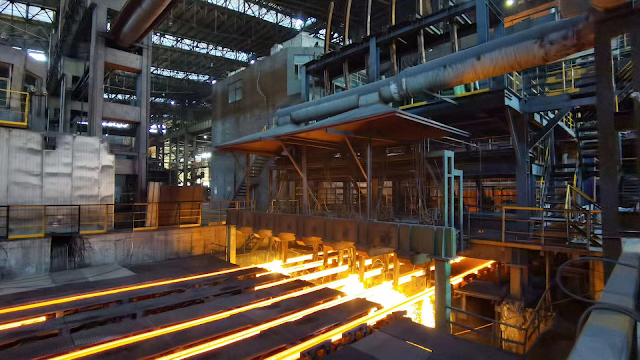
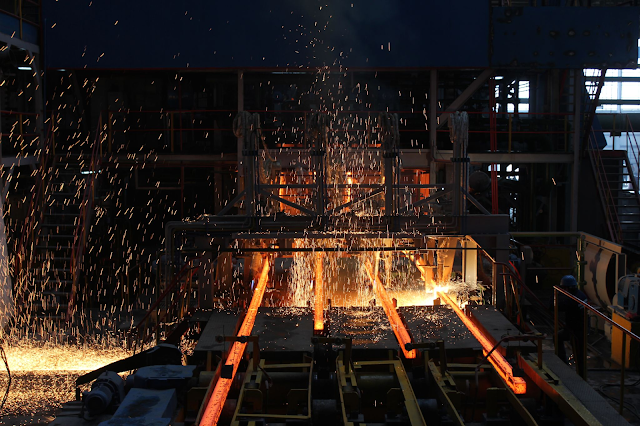
1. Requirements of the continuous casting production process on continuous casting equipment:
1) It must be suitable for the whole process of high-temperature molten steel from liquid to liquid-solid and then to solid;
2) It must have high-temperature resistance, fatigue strength and sufficient strength;
3) It must have high manufacturing and installation accuracy, easy maintenance and rapid replacement, sufficient cooling and good lubrication.
2. What kinds of continuous casting machines are divided by the running track of continuous casting flow? Briefly describe the characteristics of each model?
1) Vertical continuous caster, vertical bending continuous caster, arc continuous caster, oval continuous caster and horizontal continuous caster.
2) A. vertical continuous caster: the billet shell of this caster is cooled evenly and is not subject to bending and straightening, so it is not suitable to produce internal and surface cracks, which is conducive to the floating of inclusions. However, the height of the equipment is large, the operation is inconvenient, the investment cost is high, the equipment maintenance and accident handling are difficult, the billet section, fixed length and drawing speed are limited. Moreover, the deformation of the slab belly is prominent due to the large static pressure of molten steel.
B. Vertical bending continuous caster: the tundish, mould, guide roller and dummy bar of the caster are distributed along the vertical line. The cutting machine of the tension leveler is arranged horizontally, and the pouring and cooling solidification are completed in the vertical direction. After complete solidification, it is bent by 90 ° to enter the bending section, and the billet is discharged in the horizontal direction. Its caster height is lower than that of the vertical, which is convenient for transportation, and can meet the requirements of longer length. However, due to the addition of one-time bending and straightening, it will cause cracks.
C. Arc continuous caster: it is divided into single point straightening arc continuous caster, multi-point straightening arc continuous caster and straight mold arc continuous caster.
a) Single point straightening arc continuous caster: advantages: the height is lower than that of vertical and vertical bending type, so the equipment weight is light, the investment cost is low, the installation and maintenance are convenient, the static pressure of molten steel on the slab is small, which can reduce the internal alignment and segregation caused by the strand belly, which is conducive to improving the casting speed and slab quality. Disadvantages: during the solidification process of molten steel, non-metallic inclusions tend to focus in the arc, resulting in uneven distribution of sundries in the slab.
b) Multi point straightening arc continuous caster: advantages: the deformation rate of solid-liquid interface is reduced. When the slab is straightened with liquid core, there is no internal crack, which is conducive to improving the drawing speed.
c) Advantages of straight mold arc continuous caster: it has the advantages of vertical type, which is conducive to the floating of large inclusions and the average distribution of inclusions in steel. It has higher height than vertical bending type and low construction cost. Disadvantages: the billet shell on the outer arc side of the billet is stretched, the two-phase area is easy to cause crack defects, the equipment structure is complex, and it is difficult to repair and maintain.
D. Oval continuous caster: its advantages are that its height is greatly reduced compared with arc, the static pressure of molten steel is low, the strand volume of billet is small, the central segregation of internal crack is improved, and the investment is saved by 20% - 30% (compared with arc). However, the inclusions in molten steel in the mold have almost no chance to float up, so the requirements for molten steel are strict.
E. Horizontal continuous caster: it has the advantages of the lowest equipment height, secondary oxidation of molten steel, improved slab quality, free from bending and straightening, conducive to crack prevention, simple equipment maintenance and convenient accident handling, but the separation at the connection between tundish and mold is expensive, the lubrication between mold and slab is difficult, the mold does not vibrate during blank drawing, which is suitable for the amount of small slab, Various pouring, square billet, round billet and special steel below 200mm.
3. Definition of continuous casting and rolling
The high-temperature defect-free billet produced by the continuous caster is directly rolled into a product without cleaning and reheating (but after short-term soaking and thermal insulation treatment). In this way, the process of directly connecting "casting" and "rolling" into a production line is called continuous casting and rolling.
4. Compact connection method of continuous casting and continuous rolling
Hot charging and direct rolling of continuous casting slab. The hot charging process of continuous casting billet refers to the method that the billet produced by the continuous casting machine is drawn into the heating furnace for heating without cooling, and then rolled. The direct rolling process of continuous casting slab refers to that the high-temperature slab from the caster is directly sent to the rolling mill for rolling without heating or only slight supplementary heating of the edges.
5. Advantages of continuous casting and rolling
1) simplified production process and short production cycle;
2) Small floor area;
3) Less investment in fixed assets;
4) High metal yield;
5) Good performance of steel;
6) Low energy consumption;
7) The factory staffing has been greatly reduced;
8) Good working conditions, easy to realize automation.
6. The limiting factors to improve the drawing speed
1) the limitation of drawing force;
2) Influence of slab section;
3) Influence of slab thickness;
4) Limitation of thermal conductivity of mold;
5) Effect of speed on casting quality;
6) Influence of superheat of molten steel;
7) Influence of steel grade.
7. The secondary cooling zone includes the foot roller section, support guide section and sector section.
Cooling mode of the secondary cooling zone: 1) dry cooling; 2) water spray cooling; 3) water-air spray cooling (the best effect).
8. Inverted taper
In order to reduce the air gap and accelerate the heat transfer of molten steel and the growth of green shells, the lower section of the mold is usually smaller than the upper section. Too small inverted cone will lead to premature separation of the green shell from the copper wall, resulting in air gap, reducing the cooling effect, or insufficient thickness of the green shell of the mold, resulting in leakage accident; If the inverted cone is too large, the extrusion force between the green shell and the copper wall of the mold is too large, which will accelerate the wear of the copper wall.
9. The crystallizer meets the requirements
1) Simple structure and light weight;
2) Good thermal conductivity and water cooling conditions;
3) Reciprocating up and down and adding lubricant;
4) The mould has enough rigidity to avoid affecting the quality of slab.
10. Mold vibration mode: synchronous, negative slip and sinusoidal vibration
11. Mold width adjustment method
1) Shutdown widening;
2) Translation widening;
3) Rotation plus translation widening (the most representative).
12. Basic shape of neutral roll of vertical edger
1) Flat roll;
2) Tapered roller;
3) Pass roll with flat or convex groove bottom surface;
4) Pass roll with chute bottom surface.
13. Special roll width adjustment method:
1) Scallop roll widening;
2) Roll widening with staggered roll rings;
3) Widening of roll with middle protruding block;
4) Roll widening with variable annular convex block and conical roll widening;
5) Widening of large crown roll;
6) Tapered roll widening.
14. The short hammerhead width adjusting press is divided into:
1) Start stop width adjusting press;
2) Continuous width adjusting press;
3) Swing type width adjusting press.
characteristic:
1) Start stop press: the workpiece remains stationary during operation, the positioning is accurate, and the clamping roller can prevent slab and bending;
2) Continuous term press: the compression of the workpiece is synchronized with the progress of the work, with short operation cycle, high efficiency and high surface quality of the work connection;
3) Shaking press: a combination of the above two advantages.
15. A stroke is usually required when the long hammer press widens the slab.
16. Instability during width adjustment of rolled piece:
Tilting and warping of slab.
Prevention measures for slab overturning
1) Use pass roll or taper roll with bottom cavity to prevent separation;
2) The inclined vertical roller is used to prevent the slab from rising.
Prevention measures for slab warpage:
1) Center support, two end support and three-point support;
2) Take measures to prevent downward bending;
3) Set the two vertical rollers obliquely.
17. Methods to reduce width adjustment and cutting:
1) Using convex slab method;
2) Lubrication rolling method;
3) Backward slab rolling method;
4) Convex section rolling method;
5) Rolling method with variable hole shape and size;
6) Slab end preform method.
18. Influencing factors of instantaneous speed change in rolling process:
1) The influence of rolling specification on speed;
2) Influence of roll change on speed;
Influencing factors of instantaneous speed change during continuous casting:
1) The influence of the change of tundish liquid level on the drawing speed;
2) The influence of the change of the flow cross section of the nozzle on the pulling speed;
3) The influence of steel temperature change on drawing speed;
4) Treatment of blank in transition process.
19. Insulation cover system used in tropical rolling:
Thermal insulation cover, reflection thermal insulation cover and inverse radiation thermal insulation cover (with the highest thermal insulation efficiency).
20. Online insulation technology of continuous casting slab:
1) In order to ensure that the liquid core is completely solidified before the slab reaches the shear machine, the metallurgical length should be known. In order to ensure the drawing speed and meet the needs of rolling, the length of the mold should be increased;
2) For soft secondary cooling, the temperature entering the straightener shall be above 1000 ℃;
3) After the billet is cut off, it is transported by high-speed roller table or thermal insulation roller table to reduce the temperature loss;
4) The heat dissipation of billet corners is fast, and (supplementary) heating measures shall be taken.
21. Characteristics of hot delivery and hot charging of continuous casting slab
1) Remarkable energy-saving effect;
2) The heating capacity of the furnace is improved;
3) The yield is improved;
4) Shorten the production cycle;
5) Reduce the thermal efficiency of the furnace.
22. The quality concept of continuous casting slab includes:
1) Slab cleanliness;
2) Slab surface quality;
3) Internal quality of slab;
4) Billet section shape. The surface quality of continuous casting slab depends on the solidification process of molten steel in the mold; The internal quality of billet mainly depends on the solidification process of molten steel in the secondary cooling zone.
23. Remarkable characteristics of inclusion formation in continuous casting:
1) Fast continuous acceleration, less chance of inclusion growth, small size and difficult to float up;
2) With more tundish in continuous casting, the contact time between molten steel and atmosphere and slag is long and easy to be polluted;
3) The inclusions of mold casting ingot are mostly concentrated in the head and tail. The harm of inclusions can be reduced by cutting the head and tail, but it is difficult to solve the problem by cutting the head and tail alone.
24. Cause of star crack formation:
It is mainly caused by the infiltration of copper into the molten steel in the mold, and the intergranular fracture of the billet will occur under the action of a little stress. Preventive measures: adopt Cr and Ni plating crystallizer. (Cr plating is adopted when it is thin and Ni plating is adopted when it is thick)
25. Where does the surface longitudinal crack occur in the slab? Why?
A: it mainly occurs in the center and inside of the slab wide surface.
Cause: the thickness of the primary shell is uneven, the stress is concentrated in the thin place, and longitudinal cracks occur when the stress exceeds the tensile strength of the shell.
26. Causes of surface transverse cracks:
AlN precipitates along the grain boundary.
27. Liquid surface crust:
The liquid surface crust seems to float under the mold slag layer and above the molten steel surface.
When the solid layer is in contact, the ice melts on the skin of the shell and is pulled into the mold together with the ice.
Pit: The rough surface of the billet forms wrinkles on the surface of the billet, which seriously show valley-like depressions.
Heavy skin: For transverse depressions, transverse cracks are easily generated due to the frictional force of the mold along the drawing direction. If there is molten steel leaking out at this time, if the wall of the mold can be re-solidified, the so-called heavy skin will be formed.
28. Three stages of internal crack formation:
1) The tensile force acts on the solidification interface;
2) Cause columnar intergranular cracking;
3) The liquid steel enriched with segregation elements is filled into the crack gap.
29. Bulge deformation:
It is a unique phenomenon in the continuous casting process. It is because the solidified shell of the billet is subjected to the static pressure of the internal molten steel, which makes the wide surface of the shell between the two support rollers bulge outward.
Influencing factors of slab bulge:
1) Size and shape of slab cross section;
2) Static pressure of molten steel;
3) Spacing of support rollers;
4) Thickness of solidified shell;
5) High-temperature elastic modulus of steel;
6) Shell temperature;
7) Pull speed.
Measures to reduce bulging:
1) Reduce the height of continuous caster;
2) The secondary cooling zone adopts small roll spacing and dense arrangement, and the roll spacing of the caster from top to bottom should be from dense to sparse;
3) The backup roll shall be tightly aligned;
4) Increase the cooling intensity of secondary cooling zone;
5) To prevent the cooling deformation of the backup roll, it is better to select multi-section roll for the backup roll of the slab.
30. Three-layer structure of continuous casting mold flux:
From bottom to top → slag layer; Transition layer (sintering layer); Powder slag layer.
31. Requirements for the submerged nozzle of thin slab caster:
1) There shall be a certain interval between the mold and the copper plate to ensure noncondensing steel;
2) The diameter of the nozzle can provide sufficient molten steel flow;
3) The nozzle shall have sufficient wall thickness to make it have a long service life;
4) The internal and external shapes of the submerged nozzle, especially the layout and configuration of openings, determine the flow direction of molten steel and the shape of molten steel in the mold, as well as the functional configuration caused by injection into the mold.
32. Requirements for thin slab crystallizer:
1) The crystallizer shall have good thermal conductivity and rigidity;
2) The weight should be light to reduce the inertial force during vibration;
3) The wear resistance and corrosion resistance of the inner surface are good, and there should be no problem that the copper of the mold infiltrates into the molten steel;
4) The structure of crystallizer should be simple to facilitate manufacturing and maintenance
33. Name and characteristics of thin slab continuous casting mold flux:
name:
1) Heating or not: it is divided into heating slag and thermal insulation protective slag;
2) Appearance: powder slag, solid particle and hollow particle slag;
3) From the point of view of base materials: mixed, pre-dissolved and sintered slag;
4) Whether it contains fluorine: fluorine slag and non-fluorine slag.
characteristic:
1) Thermal insulation;
2) Isolate air and prevent secondary oxidation of molten steel;
3) Purify the steel slag interface and adsorb the inclusions in liquid steel;
4) Lubricate the solidified shell and improve heat transfer;
5) Fill the air gap between the green shell and the mold to improve the heat transfer conditions of the mold.
34. Function of electromagnetic stirring technology:
1) Obviously improve the slab quality;
2) The crystal structure is improved;
3) The cooling efficiency of the first cold end is improved;
4) The central carbon segregation also decreased significantly.
35. Definition of liquid core screw-down Technology:
After the billet is out of the lower mouth of the mold, the pressure is applied to the billet shell for processing, and the liquid core is still retained in it at this time. It is to compress the billet before the end of the liquid core.
Matters needing attention:
The reduction thickness of the liquid core must be less than the maximum reduction value of the crack. The superimposed strain after reduction is lower than the critical strain of the crack. It is best to complete the reduction in the upper sector and do not concentrate in a very short area.
36. There are three kinds of heating furnaces commonly used in thin slab continuous casting and rolling production. Which one covers a large area, is the simplest and has the latest technology?
1) Tunnel roller hearth heating furnace (CSP, FTSR): heating section, soaking section, buffer section and discharge end. Advantages and disadvantages: most use, strong reliability, smooth process, flexible use, large floor area, long production line and high maintenance cost (regular replacement of heat-resistant roll).
2) Induction heating (ISP): it adopts a group of induction coils arranged on the roller table to implement heating technology in the heating furnace. Advantages and disadvantages: long buffer time, flexible adjustment of heating temperature and depth, small land occupation, immature new technology, difficult maintenance and relatively large investment.
3) CONROLL: advantages and disadvantages: the simplest, mature technology, less investment, low use and maintenance cost, easy to master, and limited unit weight of slab (increased single weight and too wide furnace lead to increased investment).
37. Is it necessary to adopt speed-up rolling for thin slab rolling?
Answer: it is not necessary, because for continuous casting and rolling, the final slag speed can not exceed 12m / s due to the limitation of blank drawing speed and continuous conditions. Since the speed condition of constant rolling temperature by synchronous speed-up rolling technology is greater than 10-12m / s, it is not necessary to use synchronous acceleration technology to control the temperature difference between the head and tail of rolled pieces.
38. Semi endless rolling:
Several intermediate billets are welded together and then rolled continuously through a finishing mill. Ferrite rolling: the rolling body should be completed before entering the finishing mill R- α Phase transition.
39. Temperature loss of continuous casting slab and billet under the same conditions: the loss of continuous casting billet is large.
40. Is there a greater possibility of cracks on the inner arc solidification front of continuous casting billet or on the outer arc solidification front?
Answer: the possibility of inner arc solidification front is large.
41. The continuous caster is divided into:
Vertical, vertical bending, arc, oval and horizontal continuous casters. (it is divided into slab, bloom, compound slab, round slab, guide slab and thin slab caster according to section size and shape).
42. Pouring temperature:
1) It refers to the temperature of molten steel in tundish.
2) Requirements for casting: the appropriate temperature should not be too high or too low, and a certain degree of superheat is required to ensure the smooth progress of casting; The upper and lower temperature in the uniform ladle is low, resulting in the temperature of molten steel in the tundish is low at both ends and high in the middle, which is difficult to control the casting. Therefore, it is required that the temperature of molten steel should be as uniform as possible.
3) Drawing speed: the weight of molten steel passing through the caster in unit time.
4) Limiting factors for improving pouring speed: a) stability of casting process; b) Quality assurance of billet; c) When the casting speed is increased, the blank drawing speed is increased accordingly, and the rolling speed of the rolling mill is also changed accordingly.
43. Primary cooling:
1) The molten steel is cooled in the mold. Function: ensure that the billet forms a certain thickness of green shell in the mold. Mold cooling water flow mode: low inlet and high outlet.
2) Secondary cooling: the cooling process is carried out in the secondary cooling section of the billet caster out of the mold. Function: spray water to cool the slab with liquid core to make it completely solidified, so as to achieve uniform cooling in the drawing process.
44. Vibration requirements of crystallizer:
1) The vibration mode can effectively prevent the leakage accident caused by the connection of blank shell;
2) Vibration parameters are helpful to improve the surface quality of slab and form slab with smooth surface;
3) The vibration mechanism can accurately and realize the arc track without impact and swing caused by excessive acceleration; 4) Equipment structure: it is easy to manufacture, install and maintain, easy to deal with accidents, and the transmission system has sufficient safety reserves.
45. Bulge volume:
The difference between the thickness of the central bulge on the wide surface of the slab and the thickness of the edge.
46. Continuous cast steel:
Continuous cast steel is a production process in which high-temperature liquid steel is continuously cast into a billet with a certain section switch and a certain size.
47. Continuous casting slab is divided into:
Slab, square billet, round billet and special-shaped billet.
48. The equipment of hot continuous casting unit usually includes:
Stepping continuous heating furnace, high-pressure water phosphorus removal device, roughing mill, flying shear, finishing mill, coiler, laminar flow cooling device, waste collection equipment and various transportation roller tables.
49. Liquid steel solidification:
1) Mold casting - obtaining ingots - billets; 2) Continuous casting - billet
50. Continuous casting ratio:
It refers to the percentage of continuous casting qualified billet output in the total steel output.
51. Selection principle of billet section:
1) Determined according to the compression ratio required for rolling;
2) The production capacity of continuous caster and steelmaking capacity shall be reasonably matched;
3) Suitable for continuous casting process requirements;
4) According to the composition of rolling mill, the variety and specification of rolled products.
52. Selection principle of caster model:
1) Meet the requirements of steel grade and Section specification: full arc is used most, straight crystallization and multi-point straightening are followed;
2) Meet the slab quality requirements:
① slab crack and central segregation;
② Purity of slab;
③ Saving construction investment is due to various new technologies. The ideal model should be low equipment height and low static pressure of molten steel, which can simplify the design of roll train. Multipoint and ellipse are more than arc design.
53. Height relationship of continuous caster:
Vertical > vertical bending > arc > oval > horizontal
54. Determination of model of continuous caster:
1) Full arc caster (small profile, billet, wire billet);
2) Full arc, multi-point and oval continuous casters for square billets and slabs of ordinary carbon steel, structural steel and low alloy steel;
3) The steel with high purity and strict quality requirements adopts direct crystallization
55. Advantages of press width adjustment:
1) High yield, the width adjustment of the press has the function of controlling the shape of the head and tail, the shape of the clamp tail is optimized, the slab deformation is uniform, the fishtail is greatly reduced, and the cutting loss is greatly reduced;
2) Large width adjustment capacity;
3) High width adjustment efficiency;
4) High width accuracy;
5) Reduce energy consumption.
56. Hazards of high molten steel temperature:
1) The billet shell is too thin when leaving the mold, which is easy to leak out;
2) The corrosion of molten steel to refractory is accelerated, which is easy to lead to out of control of casting flow and reduce the casting safety;
3) It is easy to add non-metallic and affect the quality in the slab;
4) The columnar crystal of slab is developed;
5) Serious central segregation.
57. Hazards of low molten steel temperature:
1) The nozzle is easy to be blocked, resulting in interruption of casting;
2) Scabs, slag inclusions, cracks and other defects are easy to occur on the surface of the slab;
3) Nonmetallic slag inclusion is not easy to float up, which affects the quality of inclined billet
58. Heat transfer during rolling:
1) Temperature drop caused by thermal radiation;
2) Temperature drop caused by thermal convection;
3) Temperature drop caused by water cooling;
4) Temperature drop caused by heat conduction to work roll and roller table;
5) Temperature drop caused by mechanical machining and friction
59. Function of thermal insulation cover:
The thermal radiation speed is reduced by maintaining a high ambient temperature of the intermediate material. The thermal insulation cover has low efficiency, high reverse radiation thermal insulation cover and reflection thermal insulation cover, low efficiency and difficult cleaning.
60. Composition of continuous casting equipment:
1) Main equipment:
Casting equipment, drawing and straightening equipment, cutting equipment.
2) Auxiliary equipment: blanking and finishing equipment, process equipment, automatic control and measuring instruments.
61. Cleanliness evaluation of continuous caster:
The total oxygen content of each link of molten steel entering the crystallizer.
62. Factors affecting the cleanliness of continuous casting:
1) Model;
2) Continuous casting operation;
3) Refractory quality.
63. Measures to improve slab cleanliness:
1) Slag free tapping;
2) Select appropriate refining treatment method;
3) Adopt nonoxidation casting technology;
4) Give full play to tundish metallurgical purification technology;
5) Select high-quality refractory materials;
6) Give full play to the role of crystallizer;
7) Electromagnetic stirring technology is adopted to control the casting flow movement.
64. Corner longitudinal crack:
It is caused by the inconsistency between the taper of the narrow side of the mold and the shrinkage of the green shell in the wide side direction.
Transverse crack: the billet is in the high-temperature brittle zone; Improvement measures: increase the vibration frequency of mold; Reduce the fluctuation degree of liquid level and reduce the content of N2 and Al; Avoid high temperature brittle zone.
65. The causes of liquid level crusting are:
The temperature near the liquid level is low and the molten steel is inactive, so the angle of the side hole of the submerged nozzle has an absolute influence on this.
66. Deep vibration mark:
When the mold vibrates up and down, periodic vibration marks perpendicular to the drawing direction are formed on the slab surface. Defects will occur in the valley of vibration marks, which will endanger the quality of finished products.
67. Surface bubbles (and subcutaneous bubbles):
1) Those exposed to the surface are called surface bubbles, and those hidden under the surface and close to the surface are called subcutaneous bubbles;
2) Cause of formation: during solidification, O, h, N, C and other elements in steel are enriched at the solidification interface. Bubbles are generated when the total pressure of CO, H2, N2 and other gases is greater than the sum of the static pressure of molten steel and atmospheric pressure;
3) Measures: control the total gas content in the steel.
68. Behavior of protective slag:
Note: as the protective slag is continuously brought out of the crystallizer, it is necessary to add new protective slag in batches. Each slag layer must have a thickness that meets the actual needs to ensure the use effect of protective slag.
Effect:
1) Thermal insulation;
2) Isolate air and prevent secondary oxidation of molten steel;
3) Purify the steel slag interface and adsorb the inclusions in the molten steel;
4) Lubricate the solidified shell and improve the solidification heat transfer;
5) Fill the air gap between the green shell and the mold to improve the heat transfer of the mold.
Form:
1) Base material part;
2) Auxiliary materials;
3) Melting rate regulator.
Performance:
1) Melting temperature: refers to the temperature at which the protective slag melts to a certain fluidity;
2) Melting speed: refers to the time required for a certain quality of sample to completely melt at the measured temperature;
3) Viscosity: it directly affects the speed of the slag absorbing oxide inclusions and the effect of lubricating the billet. The appropriate viscosity is determined according to the steel grade, billet section, drawing speed, etc;
4) Surface tension: it is an important parameter affecting the separation of steel slag and the absorption of inclusions by liquid slag and their discharge from steel.
69. Factors affecting the lubrication behavior of protective slag:
1) Reducing the melting temperature and viscosity of mold flux can increase the liquid friction area and reduce the friction force on the slab;
2) The higher the casting temperature, the larger the liquid friction area and the smaller the friction of slag, but for high casting speed, the process idea of low-temperature casting should be adopted; For the flux with certain melting temperature and viscosity, the liquid lubrication zone increases with the increase of drawing speed;
3) The amplitude, frequency and inverted taper of the mold increase, and the liquid friction increases; When the casting speed is constant, reducing the amplitude and vibration frequency of the mold can reduce the friction force on the billet;
4) With the increase of waveform offset rate, the positive slippage liquid friction decreases gradually, and the negative slippage liquid friction increases; Choosing nonsine wave vibration mode with appropriate waveform offset rate is an important technological measure to realize high drawing speed.
If you are looking for the continuous caster or relevant spare parts, please mail at marketing2@hanrm.com.
More Articles You May Be Interested: